Introduction
The global agricultural sector is under unprecedented pressure to enhance productivity and ensure food security for a growing population. At the heart of this challenge lies the efficient and strategic use of fertilizers, which are indispensable for replenishing soil nutrients and maximizing crop yields. Among the myriad of fertilizer options, phosphate-based products play a critical role, and Monoammonium Phosphate (MAP) has emerged as a cornerstone of modern, high-efficiency farming. Its unique chemical composition and versatility make it a preferred choice for farmers worldwide.
This article provides a comprehensive analysis of Monoammonium Phosphate within the fertilizer industry, with a particular lens on the dynamic Asian market. We will delve into its fundamental properties, explore its diverse agricultural applications, and enumerate its significant agronomic and economic benefits. Furthermore, we will examine the current market landscape and project a detailed outlook from 2025 to 2035, identifying key drivers, challenges, and opportunities that will shape the future of MAP production and consumption, especially through platforms and networks like FertradeAsia that facilitate regional trade.
What is Monoammonium Phosphate (MAP)?
Monoammonium Phosphate, commonly abbreviated as MAP, is a highly water-soluble, crystalline fertilizer with the chemical formula NH₄H₂PO₄. It is produced through a controlled reaction between ammonia and phosphoric acid, resulting in a product that typically contains approximately 11% nitrogen (N) and 52% phosphorus pentoxide (P₂O₅), giving it a common grade of 11-52-0. This high analysis, meaning a high concentration of nutrients per unit weight, is one of its primary advantages, reducing transportation and handling costs compared to lower-grade fertilizers.
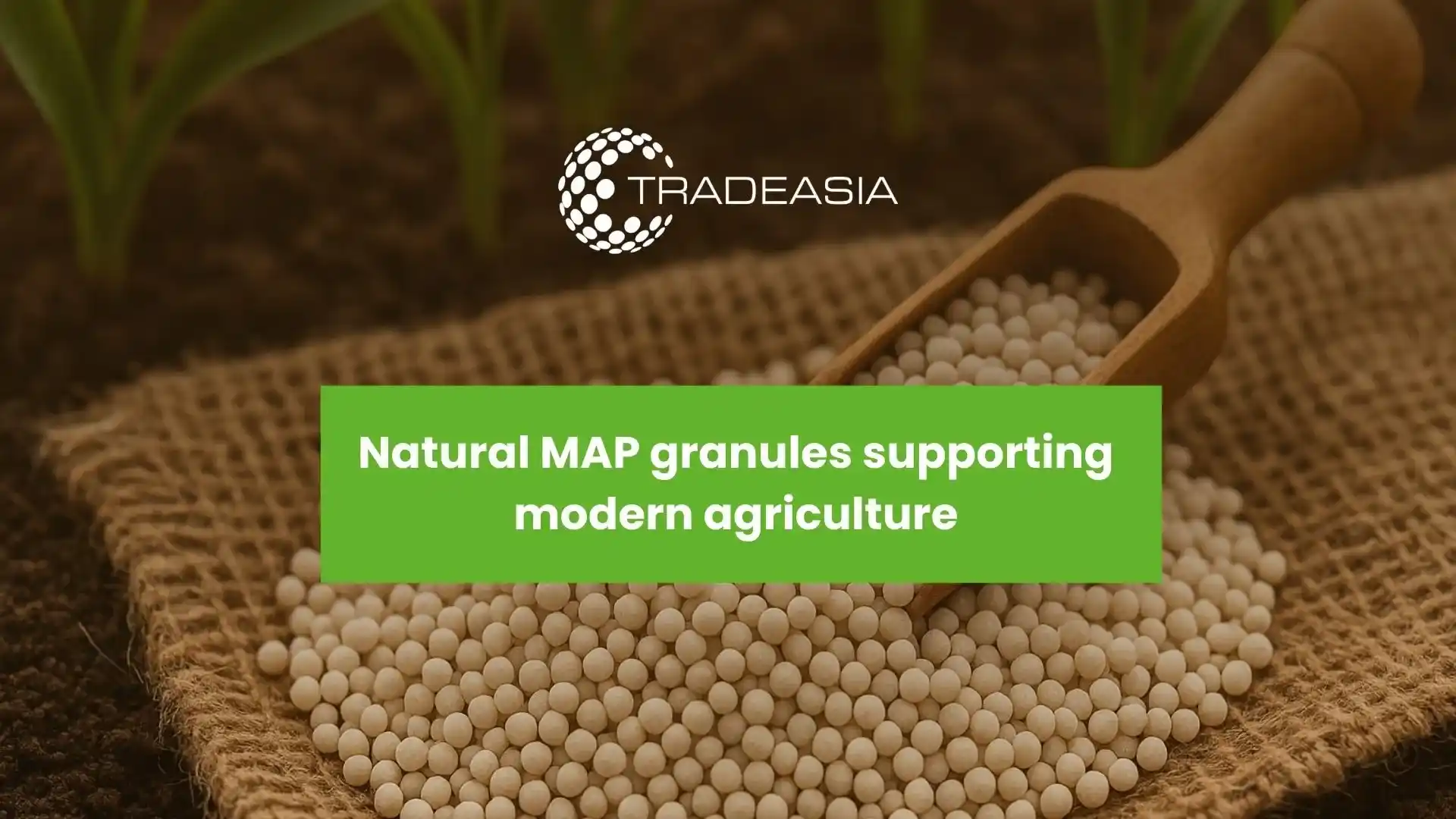
The physical and chemical properties of MAP make it exceptionally farmer-friendly. It is generally produced as gray or white granules that are free-flowing and have good storage properties. Unlike some other phosphate fertilizers, MAP is relatively stable and non-hygroscopic, meaning it does not readily absorb moisture from the air, which prevents caking. Its acidic nature (it has a pH of around 4.0 in solution) is beneficial in neutral to alkaline soils, as it can help slightly acidify the rhizosphere, enhancing the availability of other micronutrients like iron and zinc. When compared to Diammonium Phosphate (DAP, 18-46-0), another popular complex fertilizer, MAP is often preferred in situations where seed-placed fertilization is critical, as its lower ammonia content poses less risk of germination damage.
Key Applications in Modern Agriculture
The primary application of Monoammonium Phosphate is as a source of readily available phosphorus and nitrogen at the early stages of plant growth. Phosphorus is vital for energy transfer, photosynthesis, and root development, making MAP an ideal starter fertilizer. It is commonly applied in bands near the seed row at planting for crops like corn, wheat, canola, and soybeans. This placement ensures that the young, developing roots have immediate access to this essential nutrient, promoting vigorous early growth and establishment, which often translates to higher final yields.
Beyond direct soil application, MAP serves as a fundamental raw material in the production of blended fertilizers and liquid formulations. Many granular NPK blends incorporate MAP as their phosphate source due to its compatibility with other materials like urea and potash. Furthermore, it is soluble enough to be used in the manufacture of clear liquid fertilizers and is a key component in suspension fertilizers. In hydroponic and fertigation systems, high-purity, fully water-soluble grades of MAP provide precise nutrient delivery for high-value crops in controlled environments, showcasing its versatility across farming methodologies from broadacre to precision agriculture.
Benefits and Advantages of Using MAP
The agronomic benefits of Monoammonium Phosphate are substantial and well-documented. Its high phosphorus content directly supports robust root systems, which improves a plant's ability to uptake water and other nutrients, thereby increasing drought tolerance and overall plant health. The immediately available ammonium nitrogen provides a quick, non-leachable nitrogen source that supports early vegetative growth. This synergistic supply of N and P at the critical germination and seedling stages is a key driver of its effectiveness, leading to more uniform stands and earlier canopy closure, which helps suppress weeds.
From a practical and economic standpoint, MAP offers significant advantages. Its high nutrient density reduces logistics costs per unit of nutrient delivered. Its excellent physical properties ensure easy handling, storage, and application with standard equipment, minimizing waste. For farmers, the predictability and reliability of crop response to MAP provide a strong return on investment. The fertilizer's acidic reaction in the soil can also be a strategic benefit in calcareous or high-pH soils, slightly improving the solubility and availability of soil-bound phosphorus and micronutrients, making it a smart choice for challenging soil conditions prevalent in parts of Asia and the Middle East.
The Asian Fertilizer Market: A Focus on MAP
The Asia-Pacific region is the largest and fastest-growing market for fertilizers globally, and Monoammonium Phosphate is a critical component of this landscape. Demand is primarily driven by populous nations with intensive agricultural systems, notably China and India, but also expanding significantly in Southeast Asia (Vietnam, Thailand, Indonesia) and Pakistan. China is both a massive consumer and the world's leading producer of MAP, with its domestic industry heavily influencing global supply and pricing. India, reliant on imports to meet its substantial demand, is a key market for exporters from regions like the Middle East and North Africa.
Market dynamics in Asia are shaped by several factors. Government subsidy programs, particularly in India, play a monumental role in determining consumption patterns and farmer choice. The push for higher agricultural output to ensure food security continues to drive fertilizer use. Furthermore, the gradual shift towards balanced fertilization moving beyond just nitrogen to emphasize phosphorus and potassium—is increasing the demand for complex fertilizers like MAP. Digital platforms and B2B marketplaces, such as FertradeAsia , are becoming increasingly important in this fragmented market, connecting suppliers, distributors, and buyers, enhancing price transparency, and streamlining the complex logistics of fertilizer trade across the region.
Market Outlook and Future Trends (2025–2035)
The outlook for the Monoammonium Phosphate market from 2025 to 2035 is one of cautious optimism, characterized by steady demand growth intertwined with evolving challenges. Global demand is projected to grow at a compound annual growth rate (CAGR) of approximately 2-3%, with Asia remaining the growth engine. This growth will be underpinned by the need to improve yields on limited arable land, the continued expansion of high-value cash crops, and supportive policies in developing economies. However, this trajectory is not without its headwinds, including volatility in raw material (phosphate rock, sulfur, ammonia) costs and increasing environmental scrutiny.
Several key trends will define the next decade. The most prominent is the accelerating shift towards specialty and enhanced-efficiency fertilizers. While conventional MAP will remain a bulk staple, demand is rising for coated, slow-release, or stabilized MAP products that improve nutrient use efficiency (NUE) and reduce environmental losses. Sustainability will move from a niche concern to a central market driver, pushing producers to adopt greener manufacturing processes and develop products that support carbon-smart agriculture. Geopolitical factors and trade policies will continue to cause market volatility, emphasizing the need for diversified supply chains. Finally, digitalization, through platforms like FertradeAsia, will transform the supply chain, enabling data-driven procurement, precision logistics, and direct connections that make the market more efficient and responsive.
Conclusion
Monoammonium Phosphate stands as an indispensable workhorse in the global fertilizer arsenal. Its unique combination of high phosphorus content, readily available nitrogen, and excellent physical characteristics secures its vital role in foundational crop nutrition programs, particularly as a starter fertilizer. The proven benefits for early root development, crop establishment, and ultimately yield make it a rational and reliable choice for farmers aiming for productivity and profitability. As agriculture continues to intensify, the value proposition of efficient, high-analysis fertilizers like MAP only strengthens.
Looking ahead to 2035, the MAP market, especially in Asia, is poised for transformation rather than decline. While conventional product demand will persist, the future belongs to innovation—specialty formulations that enhance efficiency and sustainability. Navigating this future will require adaptability from producers, informed choices from farmers, and robust market linkages facilitated by digital trade platforms. For stakeholders across the value chain, from manufacturers on FertradeAsia to end-users in the field, understanding the applications, benefits, and evolving market dynamics of Monoammonium Phosphate is key to thriving in the complex and crucial world of agricultural inputs.
Leave a Comment