Introduction
Hydrated lime demand across the Asia Pacific fertilizer sector continues to strengthen heading into 2026, driven by rising soil acidity management needs and broader agricultural intensification. As a critical soil amendment for pH correction and nutrient availability, hydrated lime plays an increasingly important role in fertilizer formulations and land rehabilitation programs. Procurement strategies in the region are shaped by uneven domestic production, import reliance in key consuming markets, and moderate exposure to energy and logistics costs.
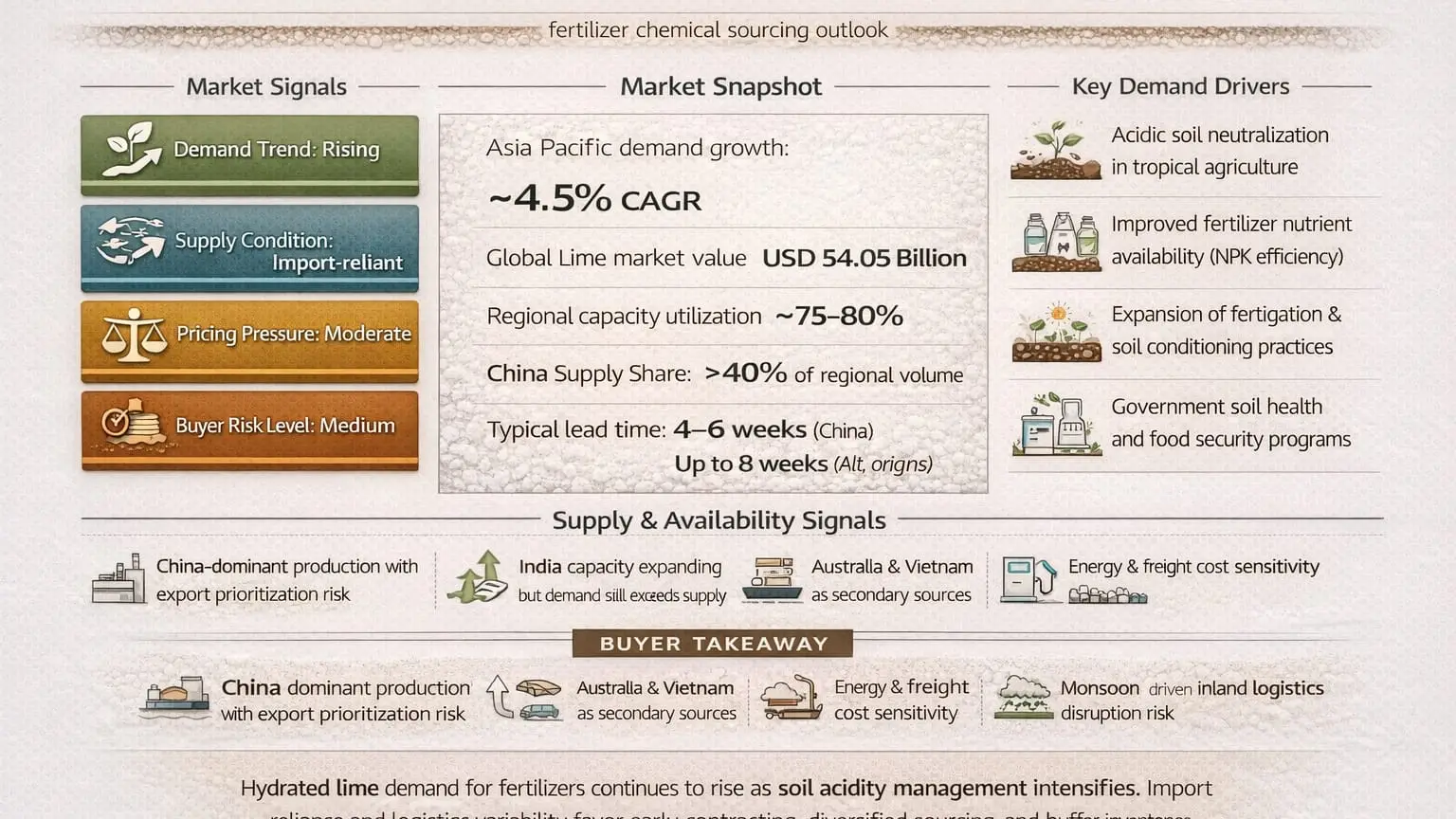
Market Signals for Hydrated Lime (Asia Pacific, 2026)
Demand trend: Rising
Asia Pacific agricultural adoption of hydrated lime for soil pH correction supports a projected regional CAGR of 4.5% through 2032, driven by crop yield optimization.
Supply condition: Import-reliant
Regional production lags behind demand in key markets like India and Indonesia, with sourcing from China and imports filling gaps amid capacity constraints.
Pricing pressure: Moderate
Energy and freight costs influence margins, but steady lime market growth at 5.9% CAGR tempers sharp increases despite raw material fluctuations.
Buyer risk level: Medium
Supplier concentration in dominant producers raises exposure, compounded by logistics variability in monsoon-prone areas.
Current Market Snapshot
Hydrated lime trade for fertilizer applications in Asia Pacific shows consistent volume growth into 2026, aligned with expanded soil conditioning and fertigation practices. The broader lime market reached an estimated value of USD 54.05 billion in 2025, underpinned by strong agricultural demand in China and India. Pricing remained stable through most of 2025, though Q4 logistics disruptions in Southeast Asia highlighted the importance of forward planning for early 2026 deliveries. Overall market conditions favor buyers that secure medium-term contracts and maintain inventory buffers during peak planting seasons.
Key Demand Drivers
Primary demand stems from the need to neutralize acidic soils, particularly in tropical and subtropical regions where high rainfall accelerates nutrient leaching. Hydrated lime enhances the effectiveness of nitrogen, phosphorus, and potassium fertilizers by improving soil pH and microbial activity. Additionally, its use in wastewater-derived fertilizer blends is expanding, as lime stabilizes pH and supports compliance with environmental standards. Government soil health subsidies and food security programs in India and Indonesia further accelerate uptake, supporting projected volume growth of 3–5% into 2026.
Supply & Availability
China remains the dominant producer, supplying more than 40% of regional demand, though export controls and domestic prioritization occasionally tighten availability for Southeast Asian buyers. India’s hydrated lime production expanded by approximately 11% in 2025, yet still falls short of fertilizer sector requirements. Alternative sourcing from Australia and Vietnam provides diversification, albeit at higher freight costs. Red Sea rerouting has added an estimated 15–20% to shipping costs for some routes, while monsoon-related disruptions increase inland transport risks. No major capacity outages have been reported, but energy price sensitivity remains a key watchpoint.
Buyer Considerations
Procurement teams prioritize suppliers that meet REACH-like purity and heavy metal standards, particularly for fertilizer-grade applications subject to tightening ASEAN regulations. Lead times typically range from 4 to 6 weeks from China, extending to 8 weeks when sourcing from alternative origins. Buffer stocks are recommended ahead of monsoon seasons and peak fertilizer demand periods. Pricing exposure is closely tied to limestone availability, coal prices, and USD exchange rates, making fixed-price or indexed forward contracts a preferred risk management tool. Quality audits are essential to ensure consistency for fertigation and blended fertilizer use.
How These Market Signals Are Interpreted
Demand indicators point to a 4.5% CAGR increase in hydrated lime imports, aligned with regional crop expansion of around 2% annually. Supply conditions reflect moderate capacity utilization at 75–80% across key producers and a high degree of concentration, with China-dominant sourcing. Pricing pressure remains controlled as moderate energy cost pass-through and stabilized freight offset raw material fluctuations. Buyer risk integrates supplier concentration, logistics delays, and regulatory compliance requirements, maintaining a medium-risk outlook.
Why This Matters for Buyers
For fertilizer producers and distributors, hydrated lime remains a strategically important input in 2026, combining steady demand growth with manageable cost exposure. However, import reliance and logistics variability necessitate disciplined procurement planning, including early contracting and diversified sourcing. Buyers that align inventory strategies with planting cycles and energy price trends will be better positioned to secure supply continuity and protect margins.
Conclusion
The Asia Pacific hydrated lime market in 2026 offers a stable yet planning-intensive environment for fertilizer buyers. Rising agricultural demand and soil health initiatives support consistent off-take, while moderate pricing and reliable production underpin availability. Nonetheless, import dependence, supplier concentration, and logistics risks keep buyer exposure at a medium level. Procurement strategies centered on multi-origin sourcing, forward contracts, and inventory buffering will be essential to navigate seasonal disruptions and energy cost sensitivity, ensuring reliable access to hydrated lime as agricultural intensity continues to increase across the region.
Leave a Comment