Introduction
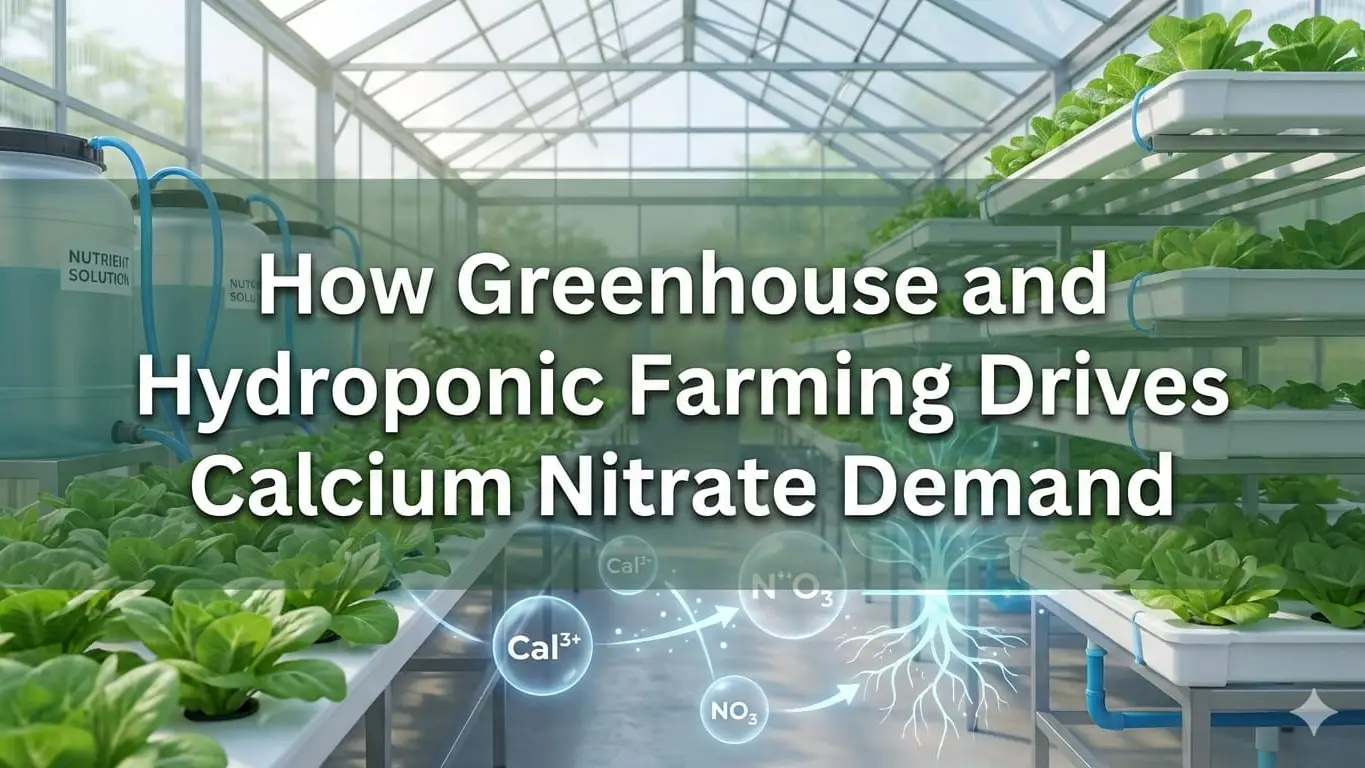
Greenhouse and hydroponic farming are reshaping how crops are grown and how fertilizers are used. These systems fall under controlled environment agriculture, where light, temperature, water, and nutrients are carefully managed to achieve consistent yields and high crop quality. Unlike open-field farming, nutrient delivery in these systems is precise, measured, and closely linked to plant growth stages.
This shift changes fertilizer demand patterns. Instead of large volumes applied to soil, growers rely on highly efficient, water-soluble products that work in closed or semi-closed systems. Hydroponic farming can reduce total fertilizer use by up to 90 percent compared with soil-based methods, yet it increases demand for specialized formulations that dissolve completely and remain stable in recirculating nutrient solutions. As a result, fertilizers that combine efficiency, purity, and predictable uptake are gaining preference, with calcium nitrate standing out as a key input.
Overview of Greenhouse and Hydroponic Farming Systems
Greenhouse and hydroponic systems form the backbone of controlled environment agriculture. Greenhouses use enclosed structures to protect crops from weather extremes while allowing control over temperature, humidity, and irrigation. Crops may be grown in soil, coco peat, or other soilless media, depending on the production model. These systems often deliver yields many times higher than open-field farming while using less water and fertilizer per unit of output.
Hydroponic systems take efficiency further by eliminating soil altogether. Plants grow in nutrient-rich water, supported by inert substrates or flowing channels. Nutrient solutions are recirculated, which greatly reduces water use and allows growers to fine-tune nutrient delivery. Common systems include deep water culture, nutrient film technique, and ebb-and-flow setups. Many operations combine hydroponics with greenhouse structures, creating highly productive and resource-efficient growing environments.
Growth in controlled environment agriculture remains strong worldwide. Urbanization, land constraints, climate variability, and food security concerns are driving investment, especially in Asia-Pacific and Europe. Vertical farms and large-scale greenhouses continue to expand, reinforcing demand for fertilizers designed specifically for these systems.
Importance of Calcium Nitrate in Controlled Environment Farming
Calcium nitrate plays a central role in greenhouse and hydroponic farming because it delivers calcium and nitrogen in a form that plants can absorb immediately. Its high solubility makes it well suited for fertigation and nutrient solutions, where consistency and reliability are essential.
With the chemical formula Ca(NO₃)₂, calcium nitrate typically provides about 15.5 percent nitrogen in nitrate form and around 19 percent calcium. These nutrients are available without causing major shifts in solution pH, which is important in sensitive soilless systems. Calcium supports strong cell walls, root development, and resistance to stress, while nitrate nitrogen drives vegetative growth and chlorophyll formation.
In controlled environments, crops grow faster and produce higher yields, which also increases their sensitivity to nutrient imbalances. Calcium nitrate helps manage these risks by reducing common disorders such as blossom end rot in tomatoes and tip burn in leafy greens. Consistent application through fertigation supports uniform growth, better fruit quality, and longer shelf life.
Key Factors Driving Calcium Nitrate Demand
Expansion of greenhouse farming is a major driver of calcium nitrate demand. Greenhouse vegetables such as tomatoes, cucumbers, and peppers require steady calcium supply to maintain quality under rapid growth conditions. Many regions support protected cultivation through subsidies and development programs, further increasing fertilizer demand.
Hydroponic adoption adds another layer of growth. These systems depend on high-purity, fully soluble fertilizers that perform well in recirculating nutrient solutions. Calcium nitrate meets these requirements and integrates easily with automated dosing systems, making it a preferred choice for urban farms and vertical growing operations.
Precision nutrient management also supports rising demand. Drip irrigation, sensors, and automated controls allow growers to apply nutrients exactly when and where plants need them. Water-soluble calcium nitrate fits well into these systems and helps growers comply with stricter environmental rules related to nutrient runoff and nitrogen use.
Application Trends in Greenhouse and Hydroponic Farming
Fertigation is the dominant method of applying calcium nitrate in controlled environments. Nutrients are delivered directly to plant roots through drip lines or flowing systems, often guided by real-time measurements of electrical conductivity and pH. Automated systems reduce labor needs and improve consistency, while recirculation minimizes waste.
Calcium nitrate works well in multi-part nutrient programs when managed correctly. It is commonly used alongside other nitrate-based fertilizers to support balanced nutrition without causing precipitation issues. This stability is especially important in hydroponic systems where solution clarity and consistency affect plant health.
Crop-specific dosing continues to evolve as growers rely more on data-driven decisions. Tomatoes and peppers typically receive higher calcium levels to prevent fruit disorders, while leafy greens and strawberries use lower concentrations to support steady growth without stress. Increasing use of software and artificial intelligence helps fine-tune these rates, improving yields and resource efficiency.
Market Impact on Calcium Nitrate Supply and Pricing
Rising demand from greenhouse and hydroponic farming is placing upward pressure on calcium nitrate supply chains. Consumption linked to controlled environment agriculture is growing faster than traditional agriculture, especially in regions investing heavily in protected cultivation.
This demand shift affects pricing. High-purity, water-soluble grades suitable for fertigation often command premiums over standard agricultural products. Energy costs and raw material availability also influence prices, while suppliers adjust logistics to support just-in-time delivery for intensive farming operations.
Despite these pressures, efficiency gains in production and distribution help moderate extreme price swings. The growing importance of controlled environment agriculture continues to reshape how calcium nitrate is produced, marketed, and supplied.
Future Demand Outlook
Demand for calcium nitrate in greenhouse and hydroponic farming is expected to grow steadily through 2033. Short-term growth remains supported by ongoing investments in controlled environment projects, particularly in Asia-Pacific. Medium-term expansion is driven by vertical farming and urban agriculture, where reliable nutrient control is essential.
Over the longer term, sustainability goals, precision farming technologies, and regulatory pressure to reduce nutrient losses strengthen the role of calcium nitrate. Its compatibility with efficient fertigation systems positions it well as controlled environment agriculture continues to expand globally.
Strategic Insights for Fertilizer Suppliers
Suppliers serving greenhouse and hydroponic farming systems are increasingly focused on product purity, solubility, and consistency. Calcium nitrate grades designed for controlled environments must dissolve completely, remain stable in recirculating systems, and deliver predictable nutrient availability across fast crop cycles. Blends that include micronutrients or are tailored for specific crops such as tomatoes, lettuce, or strawberries are gaining traction as growers seek simplified nutrient programs.
Distribution strategy has also become a competitive factor. Controlled environment agriculture relies on timely, reliable deliveries and regional availability, especially as just-in-time fertigation becomes standard practice. In this context, working with established supply partners helps reduce sourcing risk and maintain product quality. Chemtradeasia supports greenhouse and hydroponic growers with consistent calcium nitrate supply, regional logistics coverage, and technical insight aligned with modern fertigation systems. Businesses looking to strengthen their fertilizer sourcing for controlled environment agriculture can explore product options and regional support by visiting fertradeasia.com.
Conclusion
Greenhouse and hydroponic farming are driving a clear shift in fertilizer demand toward efficient, water-soluble, and high-performance products. Calcium nitrate fits these requirements by delivering readily available calcium and nitrogen in a form suited to precision nutrient systems. As controlled environment agriculture continues to grow, calcium nitrate is expected to remain a cornerstone fertilizer, supporting consistent yields, high crop quality, and sustainable production practices worldwide.
Leave a Comment