Introduction
Micronutrients play a quiet but important role in modern farming. Even though crops need them in very small amounts, they support core plant functions that shape growth, yield, and crop quality. As agriculture becomes more intensive and the same land is used season after season, shortages of these trace elements appear more often, even in fields that receive enough nitrogen, phosphorus, and potassium. Balanced micronutrient use helps plants make better use of major nutrients, strengthens overall crop health, and supports soil productivity over the long term. Among all micronutrients, copper has gained particular attention, especially in high-yield systems and controlled growing environments where nutrient precision matters.
Copper, along with micronutrients such as iron, zinc, manganese, boron, and molybdenum, supports processes like photosynthesis, enzyme activity, nutrient movement within the plant, and natural disease resistance. When copper is limited, crops may not fail outright, but performance slowly drops through weaker growth, lower yield, and reduced quality. Continuous cropping, alkaline soils, and low organic matter often reduce copper availability, especially in cereals and horticultural crops. Growing pressure from climate variability and rising food demand has pushed farmers to look more closely at copper-based fertilizers as a practical way to maintain crop resilience and protect yields under increasingly demanding conditions.
Overview of Copper Sulphate Pentahydrate
Copper sulphate pentahydrate is one of the most widely used copper sources in agriculture. It is valued for its consistent copper content, easy handling, and strong performance across different fertilizer types. Its ability to dissolve quickly in water allows copper to reach plants efficiently, making it suitable for both soil and foliar applications.
Composition and Physical Characteristics
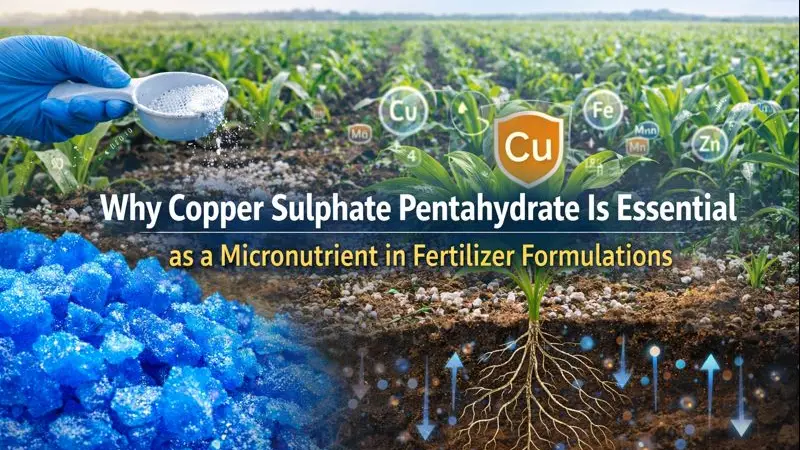
Copper sulphate pentahydrate has the chemical formula CuSO₄·5H₂O and is commonly known as bluestone due to its bright blue crystal appearance. It typically contains about 25 percent copper by weight, which allows precise dosing in fertilizer formulations. Its high purity and consistent quality make it suitable for agricultural use worldwide. In addition to fertilizers, it is widely used in fungicides, algaecides, and industrial processes, supporting stable global production and availability.
Nutrient Value and Solubility
This form of copper sulphate dissolves easily in water, especially at higher temperatures, which makes it practical for liquid fertilizers and foliar sprays. It delivers copper in a form plants can absorb directly, along with sulfur as sulfate, another useful nutrient. Together, these nutrients support photosynthesis, nitrogen use, respiration, and the formation of strong plant tissues that resist disease and lodging.
Why the Pentahydrate Form Is Preferred
The pentahydrate form is favored because it is stable, free-flowing, and easy to handle during storage and blending. Its predictable copper content simplifies formulation and quality control for fertilizer producers. Compared with other copper sources that may absorb moisture or vary in composition, copper sulphate pentahydrate offers reliability and consistent field performance, which explains its widespread use in compound and specialty fertilizers.
Why Copper Sulphate Pentahydrate Is Widely Used in Fertilizer Formulations
Copper sulphate pentahydrate serves as a dependable copper source that fits easily into different fertilizer systems. It supports enzyme activity, photosynthesis, and disease resistance while remaining compatible with common application methods used by farmers.
High Solubility and Plant Availability
Its excellent water solubility allows fast preparation of foliar sprays, fertigation solutions, and soil drenches. This ensures copper becomes available to plants quickly, even in soils where nutrient movement is limited. Compared with less soluble copper forms, it offers faster correction of deficiencies and more predictable results.
Compatibility with Fertilizer Blends
Copper sulphate pentahydrate mixes well with NPK fertilizers and other micronutrients without causing reactions or sediment formation. This allows manufacturers to create balanced blends for cereals, fruits, vegetables, and oilseeds. Its stable structure helps maintain uniform nutrient distribution in both solid and liquid fertilizers.
Cost Advantage Compared to Chelates
While chelated copper products perform well in high-pH soils, they are significantly more expensive. Copper sulphate pentahydrate provides around 25 percent copper at a much lower cost, making it suitable for large-scale farming. For most neutral to slightly alkaline soils, it delivers reliable results without the higher expense of chelated alternatives.
Application Methods in Fertilizer Use
Copper sulphate pentahydrate adapts well to different application methods, allowing farmers to choose the approach that best fits their crops and soil conditions.
Soil Application
In granular or powder form, it blends into base fertilizers applied before planting. This method provides a steady copper supply to roots and works well in large field crops such as wheat, rice, and maize. While fixation can occur in high-pH soils, proper rates and placement help maintain effectiveness.
Foliar Application
When dissolved for foliar spraying, copper sulphate pentahydrate allows plants to absorb copper directly through leaves. This approach delivers quick results and avoids soil-related limitations. It is widely used in fruits, vegetables, and other high-value crops where fast correction and crop quality matter.
Fertigation and Liquid Fertilizers
In fertigation systems, copper sulphate pentahydrate dissolves fully and moves evenly through drip or sprinkler irrigation. This supports precise nutrient delivery in greenhouses, orchards, and intensive vegetable production. Matching copper supply to crop demand helps reduce waste and improves overall nutrient efficiency.
Market Relevance and Industry Adoption
Copper sulphate pentahydrate remains highly relevant as agriculture focuses on efficiency, sustainability, and food security. The global micronutrient fertilizer market continues to expand as intensive cropping reduces trace element levels in soils. Copper-based products form an important part of this growth, supported by their affordability and proven performance.
Commercial farming operations, particularly in Asia-Pacific, rely on copper sulphate pentahydrate to support cereals, fruits, vegetables, and aquaculture. Its nutritional and protective properties align well with integrated pest management programs and export quality standards. Looking ahead, demand is expected to grow steadily as slow-release technologies improve efficiency and targeted application becomes more common. Even as regulations tighten around copper use, copper sulphate pentahydrate is likely to remain a core micronutrient source due to its balance of effectiveness, cost, and adaptability across modern fertilizer systems.
Conclusion
Copper sulphate pentahydrate continues to stand out as one of the most practical and reliable sources of copper in modern fertilizer formulations. Its stable composition, high solubility, and consistent copper content make it easy to use across soil, foliar, and fertigation applications, giving farmers flexibility in how they address micronutrient deficiencies. By supporting key plant processes such as photosynthesis, enzyme activity, and disease resistance, it helps maintain crop strength, yield, and quality in both field crops and high-value production systems.
As agriculture faces increasing pressure from intensive land use, soil nutrient depletion, and rising food demand, the role of effective micronutrient management becomes more important. Copper sulphate pentahydrate meets this need by offering a balance of performance, affordability, and wide compatibility with common fertilizer blends. While regulations encourage careful and targeted use of copper, its proven benefits and adaptability ensure it remains a core micronutrient input for farmers and fertilizer producers seeking stable, efficient, and sustainable crop nutrition solutions.
Leave a Comment