Introduction
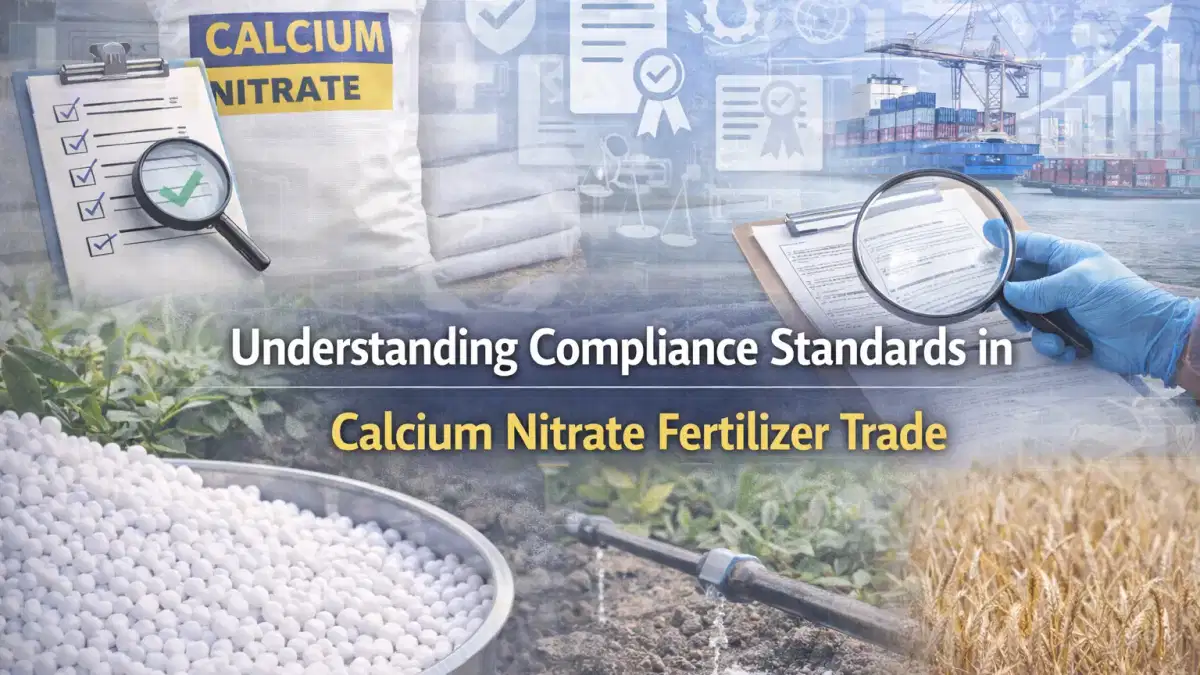
Compliance standards play a central role in the global trade of calcium nitrate fertilizers. They safeguard product quality, user safety, and environmental protection while enabling smoother cross-border transactions. Because calcium nitrate is both a nutrient source and an oxidizing substance, regulators closely control how it is produced, labeled, transported, and applied. Failure to comply often results in shipment delays, financial penalties, or outright market exclusion, especially under strict regimes such as EU REACH or trade notifications governed by the World Trade Organization.
International standards define minimum nutrient content, acceptable impurity limits, and physical properties to ensure calcium nitrate supports crop growth without creating downstream risks. Certification and laboratory testing from accredited bodies verify conformity, strengthening buyer confidence and reducing the circulation of substandard products. As nitrate pollution regulations tighten globally, compliance increasingly becomes a commercial necessity rather than a regulatory formality.
Regulatory Framework Governing Calcium Nitrate Trade
The regulatory framework for calcium nitrate trade combines fertilizer registration rules, safety classifications, and customs systems that recognize its dual role as a plant nutrient and an oxidizing agent. These frameworks vary by country but are broadly aligned with UN GHS labeling rules and WTO trade principles.
Fertilizer Registration
Most importing countries require calcium nitrate fertilizers to be registered before sale. Authorities such as the European Chemicals Agency or Australia’s APVMA assess product purity, nutrient claims, toxicity data, and environmental impact. Registration dossiers typically include chemical composition, safety studies, and field performance data, with approval timelines ranging from six months to two years. Without registration, imports are blocked regardless of market demand.
For manufacturers and distributors managing multi-country portfolios, consistent registration support and documentation control become critical. Fertradeasia, as a trusted chemical partner for fertilizer production solutions, supports buyers by aligning product specifications with regional registration requirements, reducing approval risks when entering regulated markets.
Safety Regulations
Calcium nitrate is classified as an oxidizer under UN 1454, which imposes strict handling and storage rules. Warehouses must separate it from combustible materials, maintain proper ventilation, and control temperature to prevent decomposition. Transport regulations under IMDG and national dangerous goods laws require spill containment measures and trained personnel.
Non-compliance often leads to rejected shipments or penalties at ports, increasing landed costs and disrupting supply schedules. Buyers increasingly favor suppliers with proven safety management systems to minimize these risks.
Classification Standards
Customs classification determines how calcium nitrate is taxed and inspected. Non-fertilizer grades typically fall under HS code 2834.29, while fertilizer applications use 3102.60 or related codes. GHS labeling requires oxidizer pictograms, hazard statements, and batch traceability details. Updates to HS and national tariff systems continue to increase scrutiny on fertilizer shipments, particularly in parcel and containerized trade.
Compliance Standards Affecting Imports and Exports
Compliance standards directly influence how calcium nitrate moves across borders, shaping documentation practices, quality benchmarks, and packaging formats.
Customs Documentation
Exporters must prepare commercial invoices, bills of lading, certificates of origin, and safety data sheets that accurately reflect product composition and hazard classification. Fertilizer-specific approvals such as conformity assessments under EU fertilizer regulations or updated HTS declarations in the United States are now mandatory.
Digital customs platforms improve clearance speed but leave little room for error. Incorrect HS codes or missing certificates commonly result in shipment holds, demurrage costs, and contract disputes.
Quality Specifications
Most markets require calcium nitrate fertilizers to meet minimum nutrient levels, commonly around 15.5 percent nitrogen and 19 percent calcium, while restricting impurities such as heavy metals, chlorides, and excess moisture. Testing by accredited laboratories confirms compliance with ISO-aligned quality systems and national fertilizer standards.
For industrial buyers and blenders, reliable access to consistently tested material reduces formulation risks and downstream liability. Fertradeasia works closely with approved producers and testing partners to ensure calcium nitrate grades meet destination-specific specifications before shipment.
Packaging Standards
Packaging must protect calcium nitrate from moisture while supporting safe handling. Multi-wall paper bags with polyethylene liners or sealed bulk containers are standard. Labels display GHS symbols, UN numbers, nutrient content, and batch identifiers to support traceability throughout the supply chain. Transport rules emphasize cool, dry storage and segregation from flammable goods during sea and land freight.
Regional Compliance Variations
Compliance expectations differ significantly across regions, reflecting local agricultural priorities, environmental policies, and enforcement capacity.
Asia-Pacific
China and India dominate fertilizer consumption, supported by government programs that require local registration and efficacy testing through agencies such as ICAMA. Japan and South Korea apply tighter runoff and quality controls, favoring precision-compatible formulations. While enforcement consistency varies, ISO-based quality systems remain essential for exporters targeting the region.
European Union
Europe enforces some of the world’s strictest fertilizer standards through EU fertilizer regulations and chemical safety laws. CE marking confirms nutrient content and low contaminant levels, while storage and labeling follow CLP and ATEX guidance for oxidizers. Sustainability mandates continue to shape fertilizer formulations, favoring compliant calcium nitrate blends for high-value crops.
North America
In the United States and Canada, calcium nitrate fertilizers undergo registration under agricultural and environmental authorities, with transport governed by dangerous goods classifications. Updated customs declaration rules and biosecurity measures increase scrutiny on imported fertilizers, placing greater emphasis on accurate documentation and traceability.
Middle East and Africa
Gulf countries require regulatory approvals aligned with food safety and local standards, while parts of Africa adopt WTO-notified fertilizer specifications to protect soil health. Infrastructure gaps increase inspection frequency, making quality consistency and supplier credibility critical for importers.
Impact of Compliance Standards on Trade Operations
Compliance requirements shape day-to-day trade operations by influencing costs, lead times, and market accessibility.
Cost Implications
Registration fees, laboratory testing, audits, and compliant packaging add an estimated 5 to 15 percent to export costs. Misclassification or documentation errors can trigger penalties far exceeding the product value. Larger suppliers manage these costs more efficiently through scale, while smaller traders often struggle to remain competitive.
Lead Times and Efficiency
Approval timelines and customs inspections extend lead times, particularly for new market entry. Digital traceability systems and pre-shipment audits reduce delays, but geopolitical disruptions and freight volatility continue to challenge compliance-driven supply chains.
Market Access Barriers
Strict regimes in Europe and North America limit access for non-compliant suppliers, consolidating trade around established exporters. Strategic partnerships and third-party certifications help buyers and sellers overcome these barriers while maintaining regulatory confidence.
Risk Management and Compliance Challenges
Managing compliance risks remains a priority for calcium nitrate traders operating across multiple jurisdictions.
Non-Compliance Risks
Violations can result in fines, shipment seizures, loss of licenses, or long-term market bans. Because calcium nitrate is classified as an oxidizer, safety failures carry heightened liability, including recalls and insurance claims.
Regulatory Changes
Frequent updates to HS codes, fertilizer regulations, and environmental standards require constant monitoring. Companies that fail to adapt face shipment delays and unexpected compliance costs. Proactive regulatory tracking and legal consultation help mitigate these disruptions.
Traceability Challenges
Accurate batch tracking and documentation across multi-stage supply chains remain challenging, especially in bulk shipping. Digital systems and third-party verification increasingly support traceability, reducing fraud risks and improving audit readiness.
Future Outlook for Compliance in Calcium Nitrate Trade
Compliance standards in calcium nitrate fertilizer trade are moving toward greater harmonization and sustainability. Environmental pressure to reduce nitrate runoff is driving tighter nutrient limits and cleaner formulations, particularly in Europe and North America. Emerging markets are aligning local standards with international norms to facilitate safer imports and exports.
Digital traceability, standardized testing protocols, and globally aligned HS classifications are expected to simplify compliance over time, even as entry requirements become more demanding. These changes will favor suppliers with strong regulatory capabilities and consistent quality systems.
Conclusion
Compliance standards now define competitiveness in the global calcium nitrate fertilizer market. They influence product design, sourcing decisions, logistics planning, and long-term market access. For B2B buyers, working with suppliers that understand regulatory complexity reduces operational risk and protects downstream value.
As standards continue to evolve, partnerships focused on quality assurance, documentation accuracy, and regulatory alignment will play an increasingly important role in sustaining growth across international fertilizer supply chains.