Introduction
Citric Acid Anhydrous is an important supporting chemical in the fertilizer industry. It is mainly used to adjust pH levels and improve nutrient availability. Compared with citric acid monohydrate, the anhydrous form dissolves faster, flows better, and stores more easily. These features make it suitable for large-scale fertilizer production and fertigation systems.
Core Chemical Functions in Fertilizers
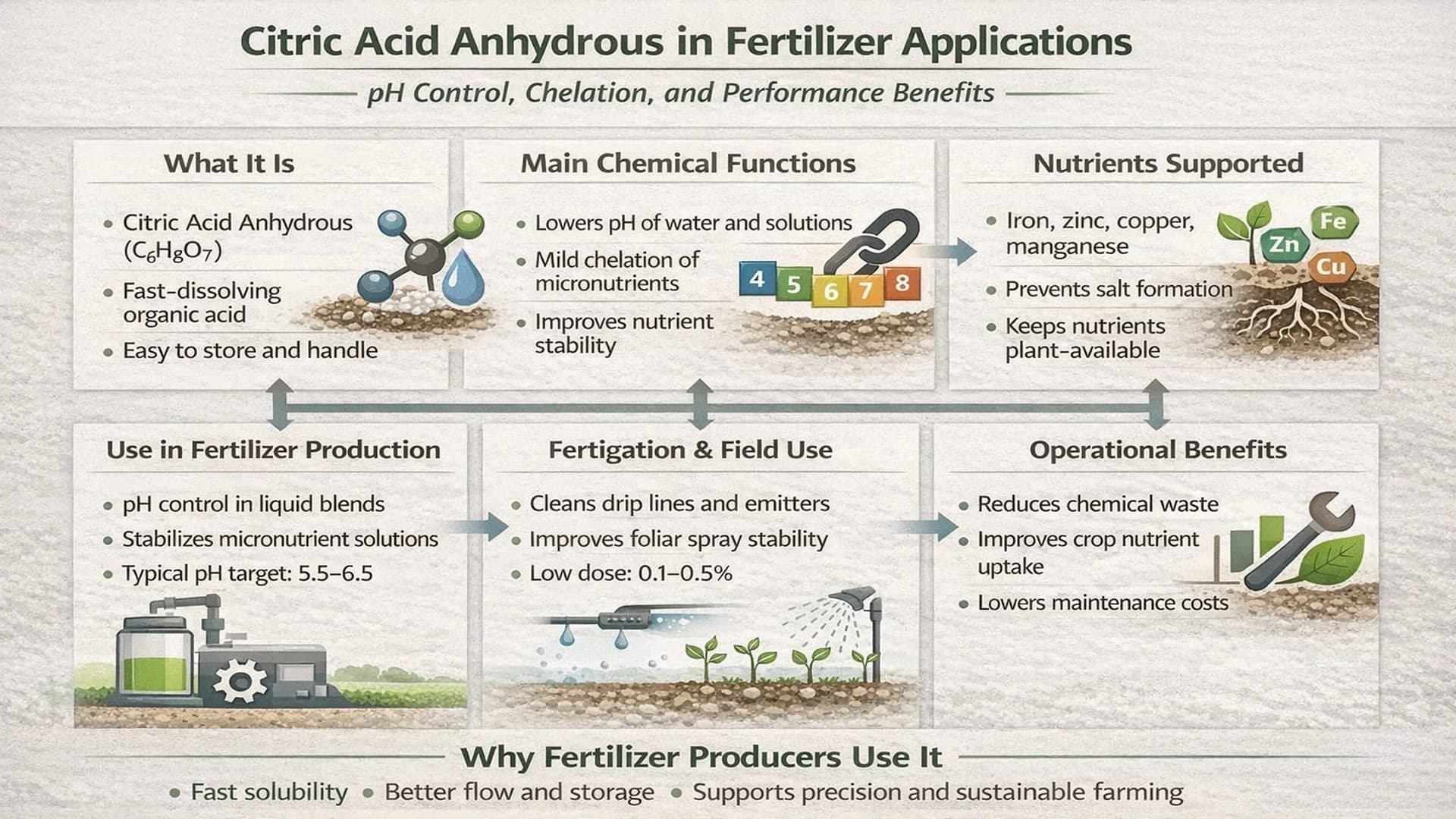
Citric Acid Anhydrous (C6H8O7) works mainly as a pH adjuster and mild chelating agent. It lowers the pH of water and fertilizer solutions, creating better conditions for nutrient stability and plant uptake. This is especially useful in alkaline soils and hard water systems, where nutrients can become unavailable.
As a chelating agent, it binds micronutrients such as iron, zinc, copper, manganese, and molybdenum. This prevents these elements from forming insoluble salts. As a result, nutrients stay in solution longer and remain available to plants. Citric Acid Anhydrous also helps reduce water hardness and total dissolved solids, which improves fertilizer mix stability without adding excess phosphorus that could harm the environment.
Role in Fertilizer Production Processes
Citric Acid Anhydrous is added during several fertilizer production steps. In liquid fertilizer blending, it is used to adjust the pH of stock solutions. Most systems aim for a pH range of 5.5 to 6.5 to keep nutrients stable and prevent precipitation.
In micronutrient fertilizer manufacturing, it is added after metal salts dissolve in water. It forms stable chelated solutions that are later mixed into NPK fertilizers or sold as separate micronutrient products. Typical dosing depends on water quality and crop needs but is usually kept low to control costs.
Fertigation systems also benefit from its cleaning effect. Citric Acid Anhydrous dissolves calcium and magnesium scale inside drip lines and emitters. This keeps water flow steady and reduces the risk of blockages, especially in long irrigation cycles.
Use During Field Application
In the field, Citric Acid Anhydrous is mainly used in fertigation and foliar feeding. In drip irrigation, it is injected into the system after filtration. It lowers water pH before nutrients enter the root zone, improving phosphorus and micronutrient availability.
For foliar sprays, it helps stabilize fertilizer mixes in spray tanks. By reducing water alkalinity, it improves leaf coverage and nutrient absorption. Application rates are usually low and follow label guidelines, often between 0.1 and 0.5 percent by weight.
Citric Acid Anhydrous is also used in soil treatment trials. Its chelating ability helps bind heavy metals, supporting soil cleanup and nutrient balance in reclaimed or contaminated land used for fertilizer testing.
Differences from Other Industry Uses
The way Citric Acid Anhydrous is used in fertilizers is different from its use in food, medicine, or detergents. In fertilizers, the main goal is to keep nutrients available at a pH range suitable for plant growth. In food products, citric acid is used mainly for taste and preservation.
Pharmaceutical applications often prefer citric acid monohydrate because of its hydration control. In contrast, fertilizer producers choose the anhydrous form because it dissolves faster and resists clumping during storage. Detergent producers use citric acid to bind metals at high pH levels, while fertilizer users avoid high pH to protect nutrient balance in soil.
Operational Value and Efficiency Benefits
Citric Acid Anhydrous improves fertilizer efficiency in several ways. Proper pH control reduces chemical waste and prevents nutrient loss. This can lower overall chemical use by 10 to 20 percent in fertilizer mixing tanks.
Its chelating action improves micronutrient uptake by crops, leading to more consistent growth and yields. In fertigation systems, regular use helps keep drip lines clean, extending equipment life and reducing maintenance costs caused by mineral buildup.
From a handling and storage view, the anhydrous form flows better and absorbs less moisture. This reduces downtime in conveying systems and supports stable storage in bulk silos. These features help distributors manage inventory more efficiently.
Sustainability and Regulatory Factors
Citric Acid Anhydrous is biodegradable and environmentally friendly. It helps reduce the need for stronger mineral acids such as phosphoric acid, which can increase runoff risks. Its low heavy metal content supports safe soil use and regulatory compliance.
New uses include controlled-release fertilizers, where citric acid helps extend micronutrient availability over several weeks. These applications support more precise and sustainable farming practices.
Conclusion
Citric Acid Anhydrous plays a valuable role in modern fertilizer systems. It improves pH control, keeps micronutrients available, and supports stable fertigation and field application. Its fast solubility, easy handling, and low dosing make it cost-effective for large-scale use. As precision agriculture and fertigation continue to grow, Citric Acid Anhydrous will remain an important input for fertilizer producers seeking better performance, lower maintenance, and sustainable nutrient delivery.