Explore our network of country and industry based websites to access localized information, product offerings, and business services across our group.
Log in to start sending quotation requests for any product.
Don't have an account? Sign Up Here
Home Ammonium Nitrate in Agriculture: Yield Performance & 2030 Outlook
Trade Insights | Applications and Buyers | 11 December 2025
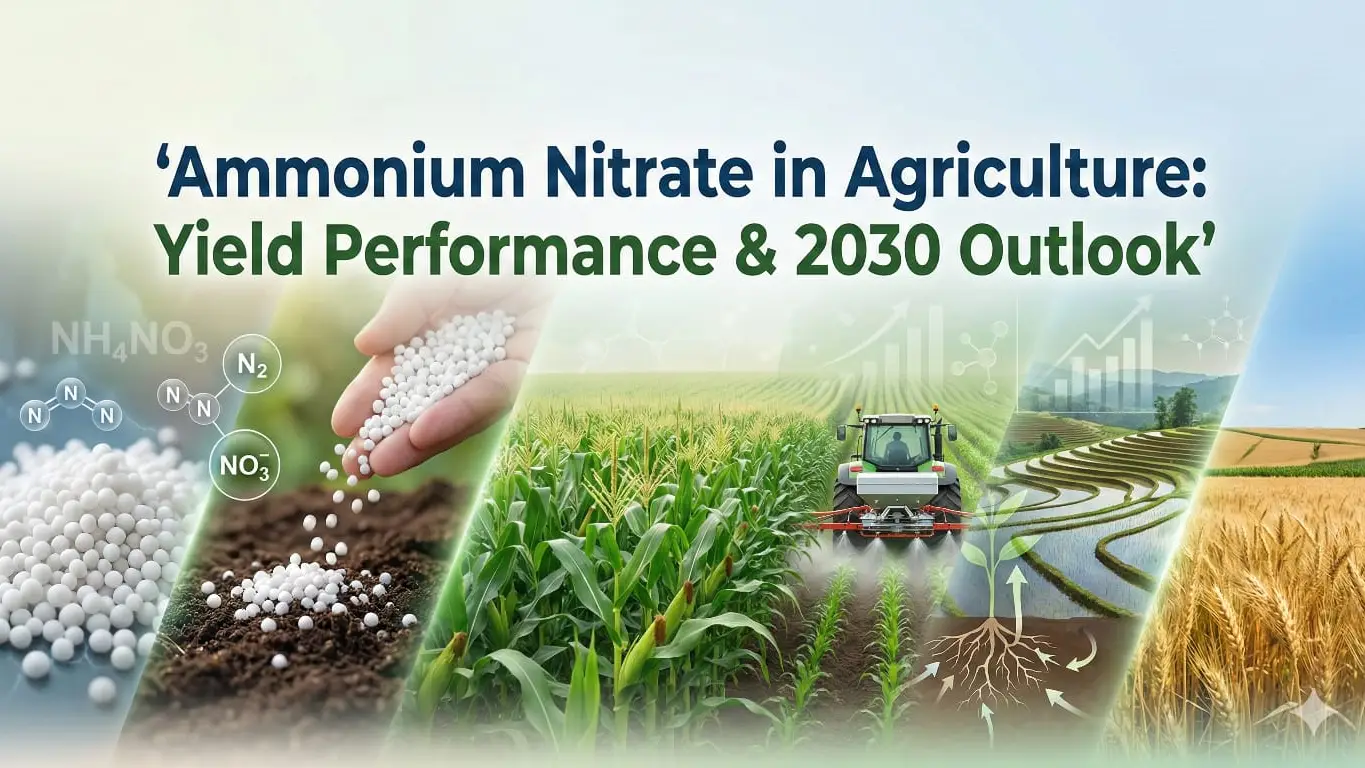
Ammonium nitrate remains one of the most reliable and effective nitrogen fertilizers used in global agriculture today. Its unique combination of fast-acting nitrate and slower-release ammonium provides crops with both immediate energy and sustained nutrition throughout critical growth stages. This dual nitrogen supply makes ammonium nitrate especially valuable in high-yield systems for rice, maize, wheat, vegetables, and pasture crops. As farmers aim to increase productivity on limited land, the efficiency and consistency of ammonium nitrate play an increasingly strategic role.
Across Asia, Europe, the Americas, and emerging agricultural regions, demand for ammonium nitrate continues to rise, supported by expanding food production needs, precision nutrient management, and growing adoption of nitrate-based fertilizers that perform better than urea in many cropping systems. Platforms such as Fertradeasia now enhance market connectivity, helping buyers and suppliers navigate fertilizer prices, availability, and international trade regulations more efficiently than ever before.
This article explores ammonium nitrate’s agronomic performance, yield benefits, effectiveness in crop systems, agricultural demand trends, and projections for 2030 across major farming regions.
Ammonium nitrate (NH₄NO₃) contains 33–34% nitrogen, split evenly between ammonium and nitrate. This balance is key to its effectiveness. Nitrate, absorbed immediately by plant roots, boosts early vegetative growth and chlorophyll production, while ammonium provides longer-lasting nutrition as it converts gradually to nitrate in the soil. The result is higher nitrogen-use efficiency (NUE) and improved yield performance compared to fertilizers that supply only one nitrogen form. Because ammonium nitrate dissolves rapidly in soil moisture, crops can absorb nutrients almost immediately.
Rice responds strongly to balanced nitrogen forms. A 75:25 ammonium-to-nitrate ratio increases seedling biomass by up to 26% and chlorophyll content by 22% compared with ammonium-only treatments.
Maize experiences around 9% higher grain yield when supplied with UAN instead of urea due to better nitrogen uptake and greater dry matter accumulation.
Vegetables, wheat, and high-value crops often show improved quality and higher marketable yields under nitrate-heavy nutrient programs.
Balanced ammonium–nitrate nutrition also reduces nitrogen losses, making more of the applied nutrient available for plant growth and helping farmers maximize returns on fertilizer investment.
Ammonium nitrate’s reliability is rooted in both its chemistry and its adaptability. It performs well across diverse soils, climates, and cropping systems. In cool or temperate environments where urea conversion slows down, the immediate availability of nitrate ensures strong early growth. In intensive tropical systems, ammonium nitrate supports rapid tillering, canopy development, and grain filling.
Performance is strongly influenced by:
Rice prefers more ammonium but still benefits significantly when nitrate is included.
Maize, wheat, vegetables, and soybeans perform best with balanced or nitrate-heavy mixes.
Correct placement such as banding or subsurface fertigation can increase corn yields by 7–14% compared to broadcast surface applications, mainly by reducing volatilization and improving root access.
Soil pH, moisture levels, and weed management play major roles in how efficiently crops convert nitrogen into yield. Trials in intercropped systems show that optimized nitrogen rates combined with good weed control produce the highest grain yields.
Ammonium nitrate is considered one of the most effective nitrogen sources available due to:
- High nutrient density (33–34% N)
- Immediate solubility and uptake
- Balanced nitrogen forms that improve chlorophyll, biomass, and protein content
- Yield boosts of 15–30% under optimized management
Unlike urea, ammonium nitrate does not require conversion before nitrate becomes available, reducing dependency on soil temperature and microbial activity. It also causes less acidification over time, supporting long-term soil fertility.
Recommended applications range from 50–100 kg/ha during tillering, top-dressing, or early reproductive stages, depending on crop needs and soil test results.
Agriculture accounts for 60% or more of global ammonium nitrate consumption, making it the primary driver of market growth. As food production intensifies worldwide, demand for efficient nitrogen fertilizers continues to rise.
The global ammonium nitrate market currently stands at around USD 20 billion and is projected to reach USD 23–31 billion over the next decade.
Fertilizer-focused segments alone are expected to grow at 3–4% annually, especially in grain- and oilseed-producing regions.
Ammonium nitrate remains at the center of modern crop nutrition thanks to its balanced nitrogen delivery, consistent yield performance, and adaptability across diverse cropping systems. From rice paddies in Asia to maize belts in the Americas, farmers rely on its efficiency to achieve higher yields and stronger nitrogen-use efficiency.
By 2030, global ammonium nitrate demand is expected to grow steadily, supported by the need for higher food production, the spread of precision agriculture, and the continued shift toward nitrate-based fertilizers. Digital platforms like Fertradeasia will play a vital role in connecting buyers, suppliers, and distributors, offering greater transparency, reliable sourcing, and streamlined trade across borders.
For stakeholders navigating fertilizer procurement, market trends, and crop management, understanding ammonium nitrate’s agronomic strengths and global demand outlook is essential to staying competitive in an increasingly data-driven agricultural economy.
We're committed to your privacy. Tradeasia uses the information you provide to us to contact you about our relevant content, products, and services. For more information, check out our privacy policy.


 English
 Indonesian
 简体字
简体字
 العربية
 Español
 Français
 Português
 日本語
日本語
 한국어
한국어
 Tiếng Việt