Explore our network of country and industry based websites to access localized information, product offerings, and business services across our group.
Log in to start sending quotation requests for any product.
Don't have an account? Sign Up Here
Home Sulphur Market Insight in Asia-Pacific: Fertilizer Demand, Supply, and Pricing Outlook (2026)
Pricing Indices | 01 January 2026
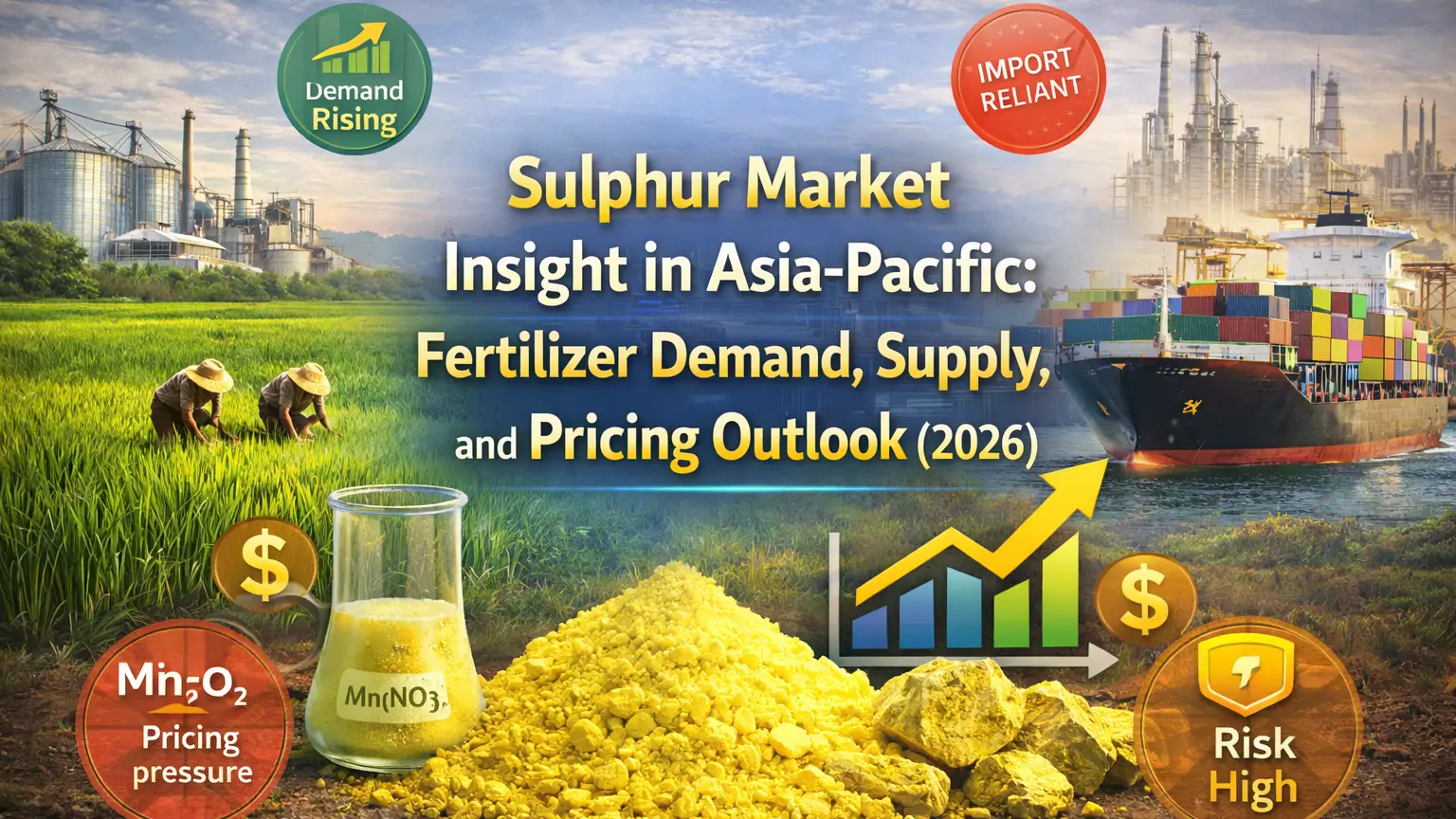
Sulphur remains a critical input for the Asia-Pacific fertilizer sector, supporting soil nutrient management and high-yield agriculture. In 2026, procurement teams are monitoring supply stability, import dependence, and price movements as regional fertilizer demand continues to rise.
Demand trend: Rising
Asia-Pacific sulfur fertilizer consumption is projected to grow steadily, with revenue expected to expand at a 2.2% CAGR through 2030 from USD 1,918.7 million in 2023. The increase is driven by soil nutrient needs in key crops, particularly rice, oilseeds, and pulses, as well as growing fertilizer application in high-yield agriculture.
Supply condition: Import-reliant
Domestic production is insufficient to meet regional fertilizer requirements. China absorbed 76% of 22 million tons of imported sulfur in 2024 due to low domestic inventories. India, Indonesia, and Southeast Asia also rely on imports from the Middle East and Russia to fulfill fertilizer-grade sulfur demand.
Pricing pressure: High
Sulfur prices rose sharply in late 2025, with Chinese port inventories low and Indonesian demand increasing. CFR prices escalated due to tight supply and shipping costs. Freight congestion, currency fluctuations, and hazardous cargo handling requirements continue to place upward pressure on landed costs.
Buyer risk level: High
Procurement faces medium- to long-term risks from logistics constraints, port congestion, and volatile freight rates on Middle East-to-Asia shipping routes. Regional buyers must manage supply timing and cost exposure carefully.
Asia-Pacific accounts for over 45% of global sulfur fertilizer consumption, with China leading demand. Fertilizer production schedules, including autumn sowing in China and rabi crops in India, drive high sulfur uptake.
Late 2025 saw aggressive spot buying as port stocks in China fell, tightening regional availability and firming prices. India and Northeast Asia experienced similar price pressure, while Indonesia added elemental sulfur procurement to balance fertilizer feedstock requirements. Overall, regional supply remains constrained against rising fertilizer demand, emphasizing the need for proactive procurement and reliable logistics management.
Soil nutrient deficiencies in oilseeds, pulses, rice, and wheat remain a major driver of sulfur fertilizer use. Governments and agribusinesses in China and India continue to invest in crop nutrition for food security, further supporting demand.
Fertilizer producers rely on sulfur for phosphate-based products, where consistent supply ensures smooth production. Population growth and intensifying agriculture amplify this requirement. Asia-Pacific sulfur fertilizer revenue is projected to reach USD 3.86 billion by 2034 at a 4.97% CAGR from 2025.
China and India dominate regional production, but combined output of around 50 million tons in 2024 does not fully cover fertilizer demand. Imports of approximately 22 million tons annually supplement local supply.
Primary sourcing comes from Middle Eastern and Russian refineries. Logistics face challenges from elevated Pacific freight rates, port congestion, and hazardous cargo protocols in China and India. Taiwan, Indonesia, and Thailand collectively imported 156,000 tons in 2024, highlighting the ongoing reliance on international suppliers.
Lead times remain extended due to hazardous material handling, emphasizing the importance of supplier reliability and robust logistics planning.
Procurement teams must prioritize suppliers with proven compliance to fertilizer-grade standards and capacity flexibility. Multi-origin sourcing strategies help manage freight volatility, currency fluctuations, and regulatory constraints.
Buffer stocks and forward contracts are critical to stabilize supply and cost. Real-time visibility into shipments, trade flows, and regulatory changes enhances risk management. Partnerships with experienced market intelligence providers, such as fertradeasia, support procurement teams in navigating complex supply chains and volatile pricing environments.
The Asia-Pacific sulfur fertilizer market is set for steady growth in 2026, driven by soil nutrient demand, high-yield crop production, and phosphate fertilizer expansion. While domestic production covers part of the regional need, import reliance, logistics bottlenecks, and price volatility remain significant challenges.
Buyers who diversify suppliers, monitor freight and currency trends, and secure long-term agreements will be best positioned to maintain uninterrupted fertilizer production. Strategic sourcing and planning are critical to manage cost, supply risk, and regulatory compliance in a high-demand environment.
Access the complete article and discover related coverage.
We're committed to your privacy. Tradeasia uses the information you provide to us to contact you about our relevant content, products, and services. For more information, check out our privacy policy.


 English
 Indonesian
 简体字
简体字
 العربية
 Español
 Français
 Português
 日本語
日本語
 한국어
한국어
 Tiếng Việt



















