
Share this product :
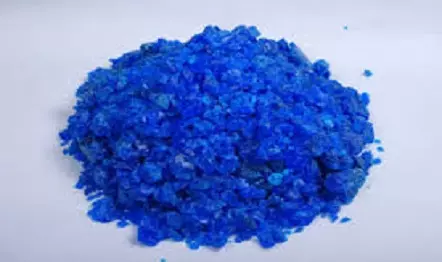
Copper Sulphate Pentahydrate
- Origin
- : China
- CAS Number
- : 7758-99-8
- HS Code
- : 2833.25.00
Basic Info
- IUPAC Name
- : copper(2+) sulfate pentahydrate
- Molecular Formula
- : CuSO4·5H2O
- Molecular Weight (g/mol)
- : 249.6900
- Synonyms & Trade Names
- : Copper sulphate pentahydrate; Blue vitriol; Bluestone; CuSO4.5H2O
- Purity / Assay (%)
- : 98.5% min
- Grade / Quality Level
- : Technical Grade
- Physical Form
- : Solid
- Concentration
- : Pure substance
- Appearance / Color
- : White to off-white solid
- Odor
- : Odorless
- Density (g/cm³)
- : 2.2860
- Solubility in Water
- : Freely soluble
- Signal Word
- : Warning
- UN Number
- : 3077
- GHS Hazard Class
- : Acute toxic; Eye irritant; Aquatic hazard
- H-Statements
- : H302|H318|H400|H410
- P-Statements
- : P260|P264|P270|P273|P280|P301+P312|P305+P351+P338|P391
- REACH Status
- : Registered
- Drug Precursor Status
- : Non-precursor
- Storage Class (GHS)
- : 6.1
- Storage Conditions
- : Cool, dry; tightly sealed
Categories
Share this product :
Brief Overview
Copper Sulfate generally refers to the sulfate salts of copper: Copper (I) sulfate and copper (II) sulfate. It is soluble in water but insoluble in alcohol. Anhydrous copper sulfate is a white crystalline solid, while the hydrated salt is blue. Prepared by the treatment of copper oxides with sulfuric acid, it is commercially available as a pentahydrate compound containing five molecules of water (CuSO4.5H2O) and is known in commerce as blue vitriol. Copper sulfate, blue stone, blue vitriol are all common names for pentahydrate cupric sulfate, which is the best known and most widely used of the copper salts.
Cupric sulfate is the most important copper salt, utilized mainly for agricultural and chemical industries. It also finds wide use in medicine and pigment industries.
Manufacturing process
In the production of copper sulfate, virgin copper is seldom used as the starting raw material. Copper ores are used in countries where they are mined. For the bulk of the world’s production, non-ferrous scrap is the raw material used. The scrap is refined and the molten metal poured into water to produce roughly spherical porous pieces about the size of marbles which are termed “shot”. This shot is dissolved in dilute sulfate acid in the presence of air to produce hot saturated liquor which, if the traditional large crystals of copper sulfate are required, is allowed to cool slowly in large cooling vats into which large cooling vats into which strips of lead are hung to provide a surface for the crystals to grow on. If the granulated crystal grades are desired, the cooling process is accelerated by agitating the liquor in water cooled vessels.
Other methods of production are:
1. By heating copper scrap with sulfur to produce copper sulfide which is then oxidized to form copper sulfate.
2. By heating copper sulfide ores to produce copper oxide which is then treated with sulfuric acid to form copper sulfate.
3. By slow leaching in air of piles of low grade ore. Bacterial action is sometimes employed to hasten the process. A solution of copper sulfate drains away from such heaps.